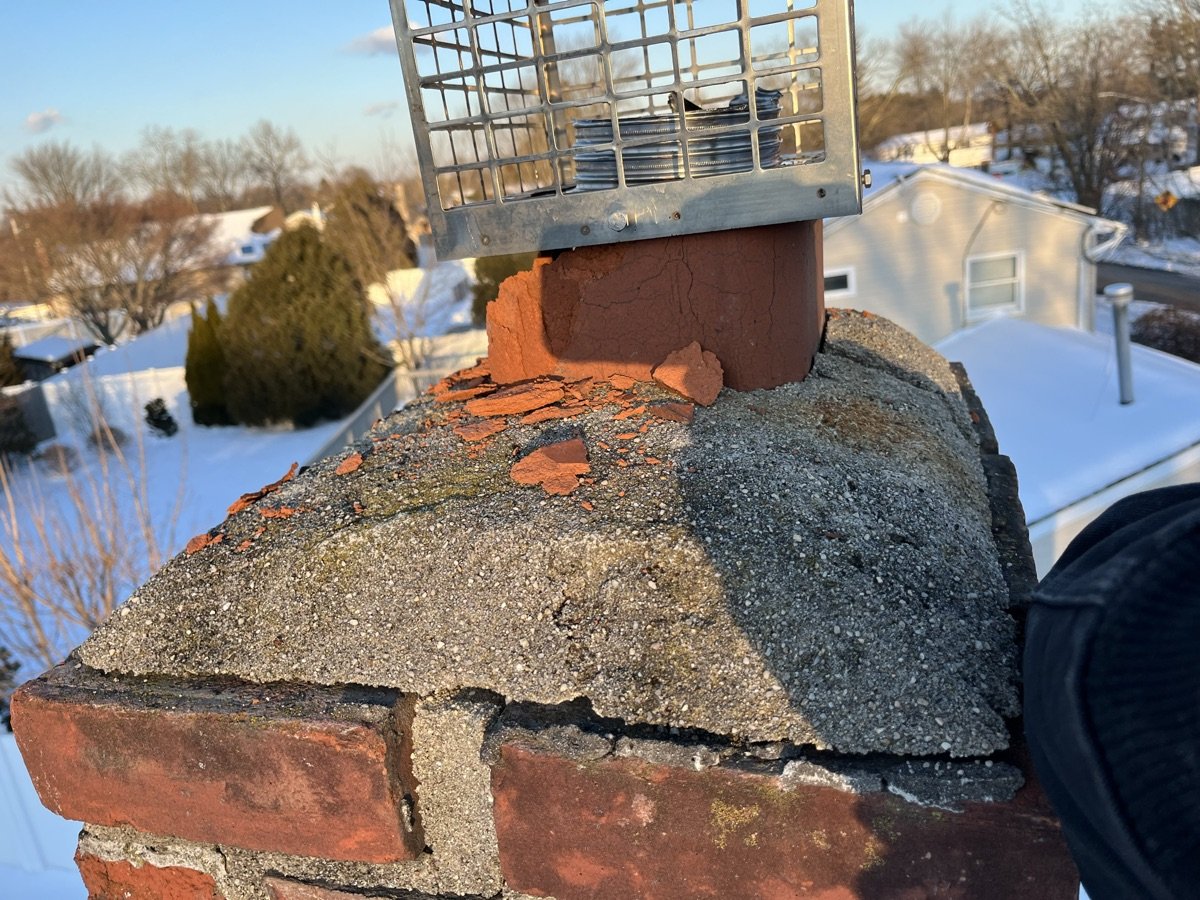
Chimney draft problems are among the most frustrating issues Long Island homeowners face with their fireplaces. A fireplace that fills the room with smoke makes the hearth unusable and, depending on severity, can pose a real health and fire risk. What makes draft problems particularly challenging is that the cause is rarely obvious -and guessing at solutions wastes money without fixing the underlying issue.
At Capstone Chimney & Masonry, we approach chimney draft problems methodically. Rather than jumping to the most common fix, we evaluate every factor that influences chimney performance: flue cross-sectional area relative to the firebox opening, liner condition and smoothness, smoke chamber geometry, damper function and position, chimney height relative to the roofline ridge and any nearby structures, building pressurization, and seasonal wind patterns that are specific to your home's orientation and lot.
The most common draft problem we diagnose on Long Island is an oversized flue. Many homes built in the 1950s through 1970s were constructed with large flues designed for appliances that no longer exist. When the firebox opening is large relative to the flue diameter, the physics of draft work against you -the cold column of air in an oversized flue easily overpowers the warm draft from your fire. The solution is typically a correctly sized stainless steel liner that brings the flue cross-section into proper proportion with the firebox opening. This single intervention resolves draft problems in a significant percentage of cases.
Negative building pressure is an increasingly common cause of draft problems in Long Island homes. As homeowners improve insulation and replace windows and doors with high-efficiency units, homes become tighter. Range hoods, bathroom exhaust fans, clothes dryers, and high-efficiency HVAC systems all exhaust air from the home without adequate make-up air supply. In these conditions, the path of least resistance for make-up air is often the chimney -which means the fireplace draws air down instead of up. Identifying this issue requires us to evaluate the home as a system, not just the chimney in isolation.
We have diagnosed and corrected chimney draft problems across all types of Long Island homes -from post-war capes in Massapequa and Levittown to large colonials in Huntington, Oyster Bay, and Garden City; from modern construction in Smithtown, Hauppauge, and Commack to East End homes in Southampton, Bridgehampton, and East Hampton where maritime wind conditions add another dimension to the diagnosis.
If your fireplace smokes, do not continue using it in hopes the problem resolves itself. Contact Capstone Chimney & Masonry at (631) 449-3086 for a professional chimney draft diagnosis. We serve Nassau County and Suffolk County homeowners with clear, honest assessments and practical solutions that last. We also offer chimney liner installation, chimney repair, and chimney sweeping throughout Long Island.